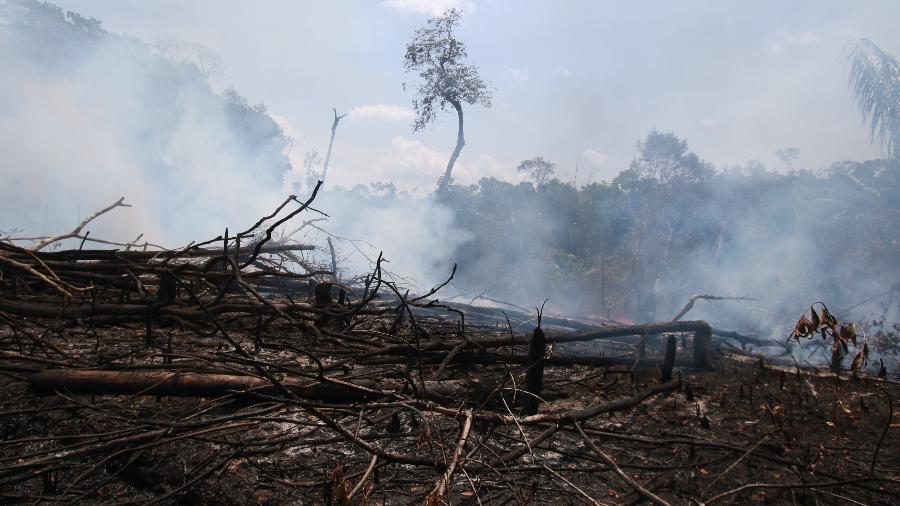
2019 was considered the period with the highest deforestation in the Brazilian Legal Amazon. According to information published by the National Institute for Space Research (INPE), the deforestation rate corresponding to the period from August 2018 to July 2019 was 9,762 km². This figure already exceeds that determined by the Project for Monitoring Deforestation in the Legal Amazon by Satellite (PRODES) in the previous year, which was 7,536 km². This means a 29.54% growth compared to 2018.
In addition, data released last Friday (12/13) indicate that the devastation in the Amazon has already exceeded the precedent in November of this year, representing an increase of 104% compared to the same month in 2018. According to With the Deforestation Detection System in the Legal Amazon in Real Time (Deter), in November alone, 563.03 km² of the biome was destroyed. This was the highest rate recorded since 2015.
Deter also pointed out an increase of 83.9% in forest deforestation in the period from January to November this year compared to the same period in 2018, from 4,878.7 km² to 8,974.31 km². This increase could be confirmed by the official measurement carried out by PRODES.
Through the mapping of images obtained by Landsat or similar satellites, it is possible to verify the extent of the devastation and, thus, quantify the deforested areas larger than 6.25 hectares. For deforestation purposes, according to PRODES, it is considered the complete removal of the primary forest cover by clear-cutting, although in the future the area may be reused.
The PRODES project
Information regarding deforestation in the Amazon is available free of charge on the INPE website, which is linked to the Ministry of Science, Technology, Innovation and Communications (MCTIC). PRODES monitors the shallow cut in the Legal Amazon through satellites and informs the annual rates of devastation of the biome. This is done by measuring increases when observing the satellite images. In this way, it is possible to obtain the values of the annual fees.
The first presentation of data always takes place in December of each year, whereas the presentation of consolidated data takes place in the first half of next year. These numbers are used by the Brazilian government in order to produce public policies for environmental preservation, in addition to being used in the approval of agribusiness production chains; agreements between States such as the United Nations Conference on Climate Change (COP 21), the National Inventory Reports on Greenhouse Gas Emissions and monetary donations by the Amazon Fund, which are based on the project as an indicator of the level of deforestation in the Amazon.
Legal Amazon
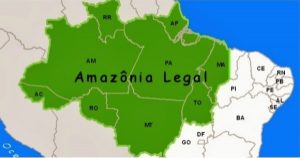
The Brazilian government created the concept of the Legal Amazon with the objective of promoting the sustainable development of the states in the Amazon region, which are:
- Acre,
- Amapá,
- Amazonas,
- Mato Grosso,
- Pará,
- Rondônia,
- Roraima,
- Tocantins,
- and part of the State of Maranhão.
Although this region accounts for an area of 5,217,423 km² corresponding to 61% of the Brazilian territory, it is the region with the lowest Brazilian demographic density, that is, only 12.4% of the national population.
In this region, is the largest hydrographic basin in the world, with a fraction of one fifth of all fresh water on Earth: The Amazon Basin covers 45% of Brazil. The Amazon River has more than seven thousand tributaries and has 25 thousand km of waterways. In the Amazon, too, there are approximately 50,000 species of plants and more than 300 species of mammals. According to the Brazilian Committee for Ornithological Records (CBRO), birds total about 1,300 species, while insects’ number in the millions. In the rivers of the Amazon Basin, it is possible to find about 1,400 identified species of fish, which represents 25% of species worldwide.
Deforestation growth
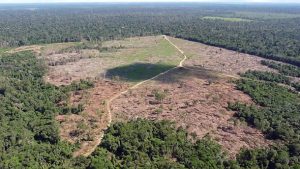
Deforestation is an alarming factor in Brazil, as it impairs the functioning of ecosystems, in addition to impacting soils and hydrographic basins. This contributed to the increase in the availability of greenhouse gases and, consequently, global warming. Between 1990 and 2010, an estimated 55 million hectares were devastated.
According to data from Global Forest Watch, this rate represents more than double the deforestation caused by Indonesia, second in the ranking. Thus, the progress of deforestation in the Amazon, between 2008 and 2018, is 170 times faster than that recorded in the Atlantic Forest at the time of Colonial Brazil.
According to data from the Institute for Environmental Research on the Amazon (IPAM), the rate of deforestation may reach annual levels between 9,391 km² and 13,789 km² by the year 2027.
In addition, this exacerbated increase in the rate of deforestation is not synonymous with wealth for the Amazon population, since the municipalities in the Amazon have the lowest HDI (Human Development Index) and IPS (Social Progress Index) in Brazil.
According to data from UNDP Brazil (United Nations Development Program), of the 62 municipalities in the state of Amazonas, none have a very high HDI, one municipality has a high HDI, 14 municipalities have a medium HDI, 40 have a low HDI and seven municipalities very low. The HDI of the state of Amazonas is considered average.
Furthermore, the economic contribution, resulting from the devastation of biomes, is negligible from an economic point of view, given that the area deforested during the period from 2007 to 2016 consolidated no more than 0.013% of the average GDP between the years 2007 and 2016.
Actions and challenges
In the government field, some actions can be taken with the aim of reducing deforestation, for example: extinction of the subsidy for deforestation, increase and efficiency of environmental inspection, combating the squatting of public lands, increase of Conservation Units, demarcation of indigenous lands, incentives for best agricultural practices, financial incentives for producers to preserve their lands, financial incentives for the Union to states and municipalities that strongly curb deforestation, prioritization of rural credit to municipalities that reduce deforestation rates.
Within companies, inspection of the entire production chain, boycott of irregular products and audits can be adopted.
In society, among the actions that can be adhered to, the demand for the extinction of public subsidies to people that devastate the environment, awareness and support for sustainable production, support for the protection of public lands, agrarian reform, demarcation of indigenous lands and conscious consumption.
After all, it is only through the implementation of effective public policies, promotion of sustainable development and the use of best agricultural practices, boycotts of irregular products, population engagement and environmental re-education, that the rate of deforestation can be reduced.