The Amazon rainforest continues to burn, and experts fear that it could spread and destroy the habitat of flooded forests where hundreds of fish species live.
The fourth largest dam in the world will flood some of the land where the population has lived for centuries.
The history of life in tropical regions has always been one of fragility. Their forests are considered the lungs of the Earth and the way they breathe affects temperature, rain and every living human being.
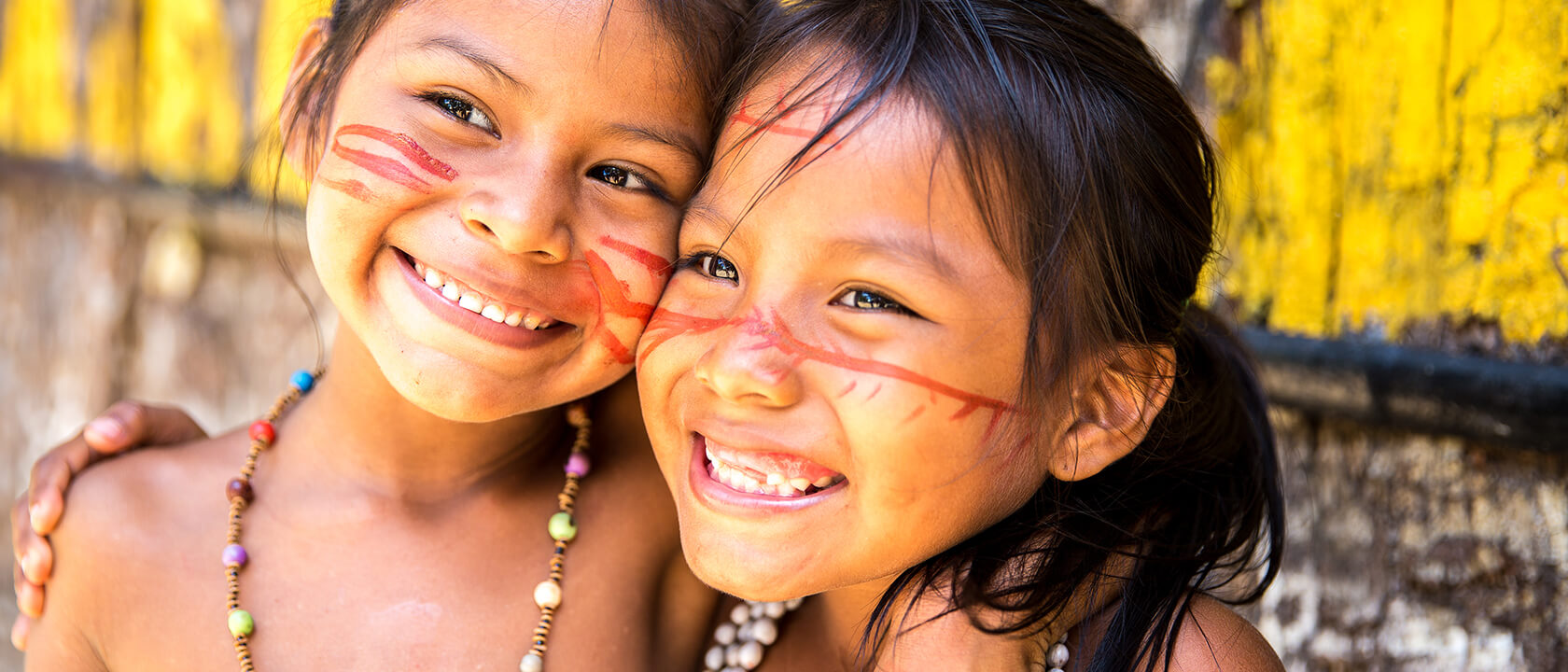
So, what happens when development arrives in the Amazon? When trees are cut, paved roads and dams built? Photographer Aaron Vincent Elkaim spent his career telling stories of indigenous peoples and ancestral places threatened by ‘progress’. In 2014, he made his first trip to the state of Pará, in northern Brazil, to witness how the Belo Monte dam, which is being built on the Xingu River, the more than 25,000 indigenous people whose lives depend on the land.
Elkaim sees the dams on the Xingu River as disturbances for people who have spent centuries living off the land and protecting it for future generations. “We have made a lot of progress in terms of reducing deforestation in the area,” says Elkaim. “But, for me, building this dam is not a symbol of protecting the future, but of destroying it”.
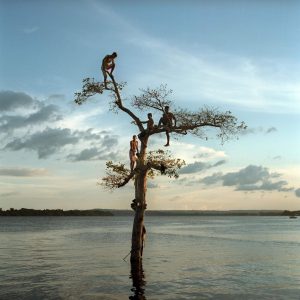
The plant is expected to fully function in 2019, but people who live nearby have seen more water on land that was once dry. During Elkaim’s various trips to the dam site and other parts of the Amazon basin, he met members of the Munduruku indigenous tribe, who placed stones to spell out protest messages. He saw how people are already adapting to changes in the watershed. While the men washed a car on flooded land, the photographer watched a group of boys climb a dead tree that was once on dry land.
In this struggle of the past versus the future, of culture versus development, government officials argue that both are possible. But water has its own way of washing things. Elkaim continues to return to the region to photograph what is at stake and people at risk. And he hopes that his images will invoke a worldwide nostalgia for the Amazon and for the people who lived in it for centuries. “The idea is to show the myth and imagination that exists within the forest,” he says. The best hope for the people who live there is that, through a lens, they will be seen.
You can continue this reading on
https://www.nationalgeographicbrasil.com/fotografia/2017/07/luta-indigena-no-brasil-na-visao-de-um-fotografo-americano