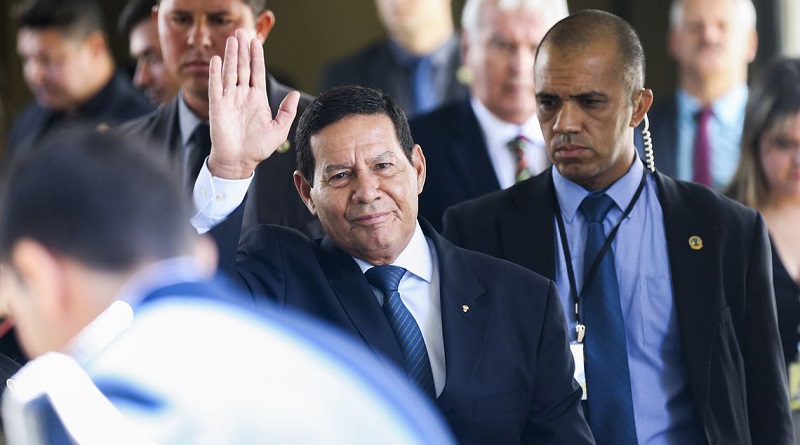
On January 21, the government announced the creation of the Amazon Council and the National Environmental Force, whose actions will begin in March 2020. This was the way to send a message to the World Economic Forum in Davos that the environment is important for Brazil. The vice-president, Hamilton Mourão, will be the main responsible for coordinating the actions at the Planalto Palace – Brazilian President Official Residence.
As a result, this announcement by the government about the creation of this new collegiate body has been discussed in the mainstream media. According to the current president, Jair Bolsonaro, the collegiate’s work will be based on the protection, defense and promotion of sustainable development in the Amazon, through an inter-ministerial apparatus, under the coordination of the Vice President of the Federative Republic of Brazil: General Hamilton Mourão.
He informed that the council initiative is embryonic, and also the creation of a presidential bill of law that will define controls between the bodies and ministries of this collegiate is in study phase.
In addition, he stated that the initiative to create this bill is due to the great criticism that the government has been facing with regard to environmental protection and fires that occurred in 2019 in large areas of the Amazon Region.
Also, as announced by the vice president, General Hamilton Mourão, there is a 1995 presidential decree that created the council, but there were legal problems that made it impossible and, therefore, the government opted for the creation of a new one.
In a meeting, on February 4th, 2020, the vice president also addressed the international view on environmental policy and its impacts on the economy:
“There will be no specific budget allocation for the Council’s actions. The funds will be relocated within the ministries and there is also the possibility that credits available in the Amazon Fund will be used”.
What will be the resources of the Amazon Council?
The board’s proposal is to seek resources from various ministries to put public policies into practice in the Amazon Region. Thus, there will be no specific budget for the agency, since the Federal Budget was not voted on, but there are alternatives in order to raise funds for the protection and preservation of the Amazon.
According to the president of the Parliamentary Front of Agriculture (FPA), representant Alceu Moreira (MDB / RS), the creation of the council will enable an improvement of the Brazilian image abroad through a unique language based on scientific data.
Still, Moreira defends that the resources are already in the ministries and, if they are unified in a single command policy, they will give better results, since the Amazon has great potential to produce what is a benefit, but it is also a favorable territory for the existence of many crimes.
In addition, Moreira points out that if the topic is dealt with sumptuously and competently in the following budget, there will be conditions to allocate the necessary resources to work on investments, production, agro-environmental marketing and, to include 25 million people residing in the Amazon, in the economic process.
It is necessary to work on alternatives for agricultural production in the Amazon Region and make progress in regulating the exploitation of minerals and wood.
The National Environmental Force
President Jair Bolsonaro also announced the creation of the National Environmental Force, which will aim to protect the Amazon Forest. As announced by the president, this body will resemble the National Public Security Force, which is composed of:
- Military;
- Civilians;
- Firemen;
- Other security professionals.
In this way, the National Environmental Force will be commanded by the Amazon Council, led by President Hamilton Mourão.
This work has always been entrusted to the Chico Mendes Institute for Biodiversity (ICMBio) and to the Brazilian Institute for the Environment and Renewable Natural Resources (Ibama) and, in some cases, the body had the support of the Army and the National Force, which will lend the template for the creation of the National Environmental Force.
The Ministry of the Environment is studying the possibility of using a percentage of the R$ 430 million (BRL) from Operation Car Wash to finance the National Environmental Force.
However, the president of the Association of Servers of the Career of Environmental Specialists (Asibama), Alexandre Gontijo, criticizes the government’s action: “They are trying to reinvent the wheel […] The Amazon is very important. It is necessary to promote sustainable development, according to the resources available in each region. The forest controls the rain regime that feeds even agribusiness. If it ends, everything else ends”.
National Security
The Amazon Forest is the largest Brazilian biome and Brazil holds most of the tropical forest and, therefore, is the main actor in terms of its preservation. Because it is the largest tropical forest in the world, it is the largest biodiversity stronghold, as it holds important representatives of the species:
- Birds,
- Mammals,
- Reptiles,
- Amphibians,
- Fish,
- Arthropods.
In addition to having endangered animals, such as:
- Maracajá cat,
- Manatee,
- Otter

Furthermore, regarding to anthropological and cultural criteria, there is great ethnic-racial variation with the existence of many traditional populations (in addition to indigenous peoples, the region has quilombolas, rubber tappers, artisanal fishermen, riverside populations, among others). It also has an urban part that is home to millions of Brazilians.
In addition, the biome is fundamental in terms of national security. There are millions of kilometers of border areas, bordering seven countries that supply part of the forest. Thus, he realizes the importance of the State’s presence in this region.
According to the professor at the Federal University of Amazonas (UFAM), the doctor of ecology Henrique dos Santos Pereira, the region’s main enemy is growing livestock, so that about 70 to 80% of the burned areas are transformed into pasture.
“There is also a social impact on local populations, with the invasion of traditional territories and indigenous lands. It is necessary that governments ensure the rights of these communities with the demarcation of lands”, warns ecologist Henrique dos Santos.
Finally, the Amazon also has essential mineral resources for Brazil. In addition, this region is of great importance for the hydroelectric sector. It is also worth mentioning the importance of this biome for the planet’s climate, since, if Brazil does not stop deforestation, the forest can become a major emitter of carbon dioxide.