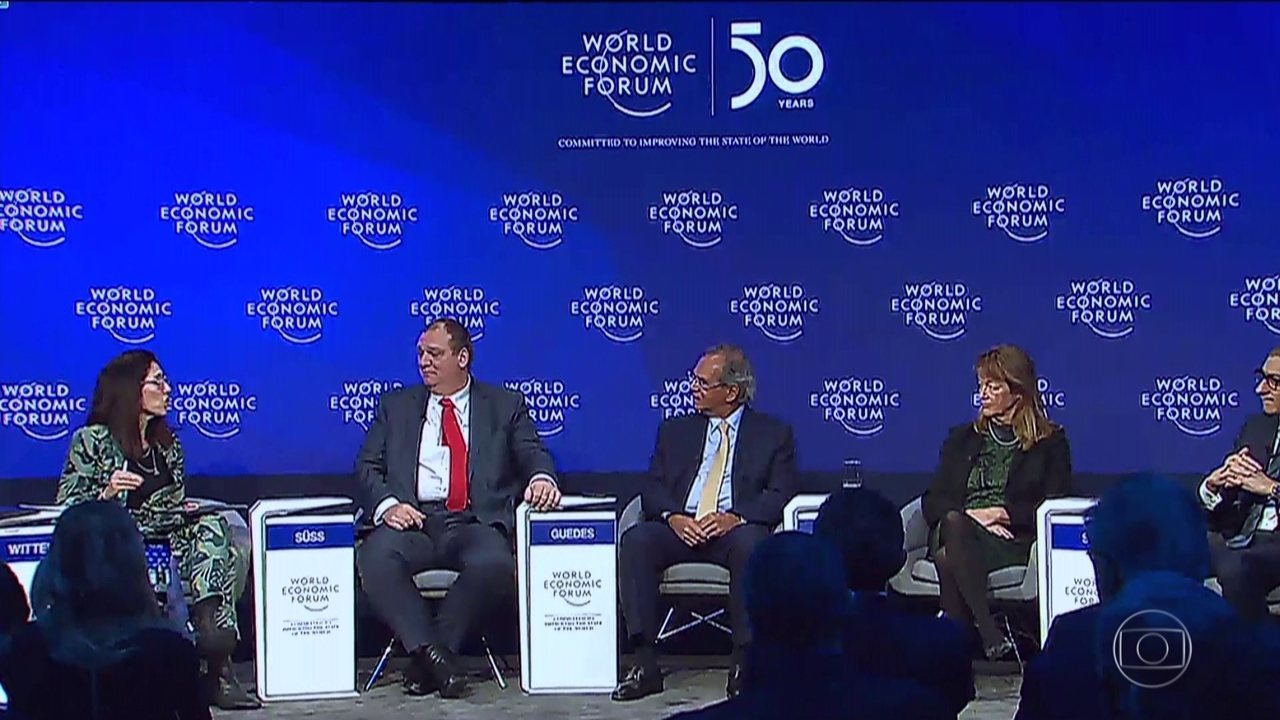
The World Economic Forum, Davos 2020, which took place from January 21st – 24th , gave a lot to talk about, both about resolutions and new directions, as well as about the presence of Brazil and its representatives.
Davos overview
With half a century of existence, the World Economic Forum, known as Davos, the name of the city hosting the event is nothing less than the initiative that brings together world leaders and representatives of the main spheres of the economy. The idea is to create and develop an action agenda based on the resolutions and guidelines from the meeting. And so it is!
Each year, a central line for debate is stipulated and, just before the Forum, the Report is published that serves as a filter in the direction of the topics chosen by several specialists and thus the dynamics of the event are being structured.
In 2020 sustainability was the focus with the theme: “Stakeholders for a more cohesive and sustainable world”, due to a turbulent 2019, with deforestation and burning in vogue in the country, Brazil was in evidence. In addition to questions about the environment, the absence of the president of the republic was also noted, the challenge of representing the country was left to the minister of the economy, Paulo Guedes, whose statements were not beaten at the meeting.
About what the Economy Minister in Davos said
After a first year of turbulent government, many controversial changes and natural disasters, the Brazilian delegation showed little concern for the central theme of the World Economic Forum and elected a modest delegation for this, which is a reference meeting and an intentional showcase of governments and organizations.
The leader of the Brazilian delegation was Paulo Guedes, Secretary of Economy, apparently Brazil’s mission in Davos was commercial, the idea was to “sell” the country, since sales of R$ 150 billion are planned for 2020, with the privatization of state-owned companies, more stakes in companies and an auction of 79 concessions, according to the Privatization Secretary of the Ministry of Economy, Salim Matar.
The fact is that Brazil’s presence was subtle, yet some comments gave us something to talk about and one of them was exactly the Minister’s statement on sustainability, when he declared that the greatest enemy of the environment is poverty.
The speech was soon questioned, since the relationship between deforestation for survival reasons has minimal relevance. Al Gore, an activist and former vice president of the United States, was one of the world representatives who spoke in relation to Guedes’ statement, questioning the meaning of the statement, saying that this is a speech that can generate false hope in those most disadvantaged . Another comment on Paulo Guedes’ statement came from journalist Dom Phillips, a correspondent in Brazil for The Guardian, asking himself about the inconsistency in the Minister’s speech, in relation to the statements of the previous year when Guedes said he was not convinced about the science of climate change.
However, what really called attention in the 50th edition of the World Economic Forum was the statement that Paulo Guedes made about GDP, saying that the growth forecast for 2020 was 2.5%. A, contrary to the general estimate (2.1%) and also raising the government’s forecast statement that previously mentioned 2.4%.
The forecast placed by Paulo Guedes was during the panel “Strategic Perspective: Latin America”, the one put forward by the government was given a week earlier. It was to be expected that there would be repercussions.
“The GDP growth in Brazil 2020 should reach 2.5%, says the Minister of Economy, Guedes, in Davos. Bold, above the 2.1% consensus and the official government forecast of 2.4%. But I think we’ve seen this before – a year ago, the 2019 market consensus was 2.6%, but it is likely to barely reach 1%,” said British Reuters journalist Jamie McGeever in a post in a of your social networks.
Davos resolutions on the environment
In the year in which the environment was the focal point of the event, of the most diverse issues on the theme, there is no denying that the debates focused on actions related to climate change. Much has been seen, countless studies pointing man as a propelling agent of disasters that happen due to this imbalance, forecasts pointing out catastrophic scenarios, at a speed inversely proportional to the measures in this sense.
The theme has been an active agent and cause for disagreement among the political actors that make up Davos, it was only possible to agree on one point, the timing. The understanding is that we are late and that there is no more margin to waste: we must change now!
Ultimately, it became very clear that climate change is the most relevant factor because it has numerous implications, especially in the economy. UN Secretary General Antonio Guterres has even declared that this will be the factor responsible for the destruction of the planet.
Current actions and “the taxes of sin”
What happens is that, in a more practical matter, even existing actions must be reevaluated, such as the carbon tax. According to the CEO of management BlackRock, Larry Fink, the tax paid on carbon is regressive and this affects the economy in different layers. For Fink, the dynamics of this tax must be sustainable, allowing companies to pay for it to make a profit.
On the other hand, in this sense, Paulo Guedes’ position was in line with the government’s premise that defends “the taxes of sin”, a thermology applied in the economy to taxes applied on companies whose products are harmful to health, such as:
- Cigarette;
- Alcoholic beverages;
- Sugary drinks and the like.
Other information
Undoubtedly, a historic and controversial edition marked the World Economic Forum 2020, it was possible to discuss:
- Jobs of the future;
- Digital economy;
- Inequality;
- The future of capitalism.
Not to mention the debates on issues, such as the social factor as a driving force for imminent economic crises, trade wars and much more.