Researchers discover a new species of tree frog in the Amazon. It is an amphibian with a powerful song, which ended up attracting the attention of scientists.
According to the researchers, thanks to the strong and different songs of the other species needed in the Amazon, it was possible the discovery. This happened in the wetlands of Rondônia.
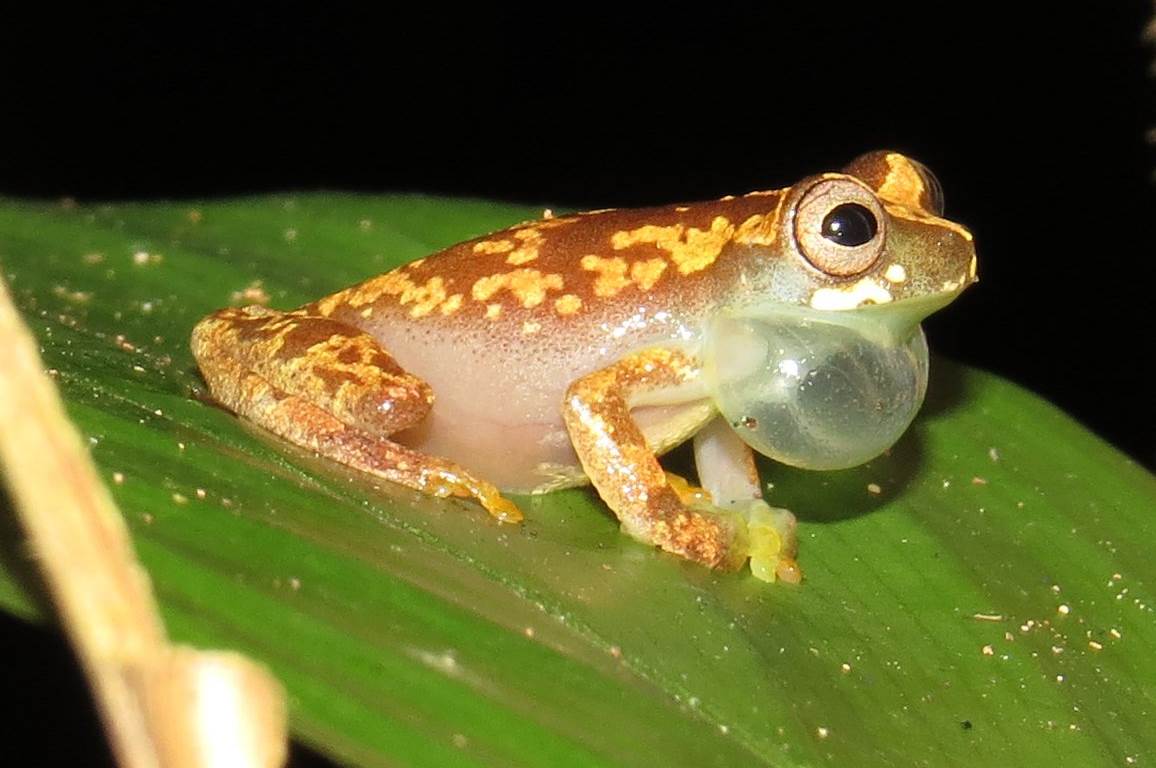
In such a way, it was possible to catalog yet another new species of amphibians for the Amazon Region. It was named Dendropsophus bilobatus and is tiny, barely larger than a human nail.
All tree frogs found were male, measuring about 20 millimeters. However, the sound emitted by this species is much more powerful than that emitted by other species of the same genus. And that was what attracted the attention of scientists.
According to Miguéias Ferrão, a Brazilian researcher at the Harvard Museum of Comparative Zoology: “We found this species, in 2011, in the flooded forests of the Jaci-Paraná River, a tributary of the Madeira River. We heard the sound and noticed that it was unusual. The frequency emitted by the species was much higher than that of other frogs. After this episode, we captured some of the new species needed in the years 2012 and 2013, and recorded the emitted sound. After separating the DNA mapping and we found that it was dealing with a new species ”.
The discovery was the subject of an article published on June 18, in the magazine ZooKeys, authored by Migueas and three other scientists: Albertina Lima, Jirí Moravec, and James Hanken.
The sound emitted by amphibians such as frogs, tree frogs, and toads, such as Dendropsophus bilobatus, is a very important factor for the individualization of the species, as it is unique:
“In most cases, the song is emitted by a male who aims to conquer the female of the same species. Sometimes, the differences between the sounds are subtle, you need a sharp ear to differentiate them. In other cases, it’s easy to see, ”says the Brazilian.
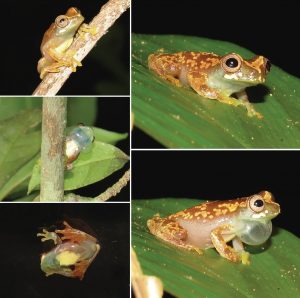
In this new species, there was no difficulty for its individualization. His vocal sac is quite peculiar: bipolar. That is, it has two wolves that turn crystal green. They resemble two balls of chewing gum.
“Dendropsophus bilobatus is identified by its sound and vocal sac. He has a nocturnal habit and likes wetlands, mainly for breeding. It usually reproduces during the waters, ”explains Miguéias.
Scientists still believe that this species can also be found in the Bolivian Amazon. Currently, 108 species of the genus are recognized, 66 of which are in the Brazilian Amazon.
Who are the Amphibians?
Amphibians are vertebrate animals that like to live in both the aquatic and terrestrial environments. They need to be in the water to keep their skin moist.
Usually, the reproduction of these animals is external and occurs in the aquatic environment. Hence the relationship of finding these species, especially in flooded regions. So, in rainy seasons, they like to reproduce.
Amphibians like freshwater, with the exception of the crab-eating frog that lives in the sea and the water-frog from the Australian Desert. Its main features are:
- Pulmonary gas exchanges;
- Skin with water inlet, where gas exchange also occurs;
- Heart composed of two atria and a ventricle, which increases blood transport;
- Presence of eardrum;
- Eyelids that protect the eyes and help with cleaning;
- Well-designed legs.
When talking about your digestive system, it says that digestion is processed in the stomach and intestine. Even having some teeth, they don’t chew their prey. The tongue, in these species, is very efficient and used to capture prey.
Amphibians do not drink water, it is acquired through gas exchanges made on their skin. Breathing may occur:
- Through the lungs, these comprise two sacs with no internal divisions;
- Through the skin;
- In the mucosa of the mouth and pharynx.
Finally, reproduction is sexual and external fertilization occurs. The female throws the eggs in the water and the male eliminates the sperm to meet those eggs. Embryos pass through a larval phase, undergo metamorphosis, and go into adulthood.
The Fauna and Flora of the Amazon
Based on the huge territorial dimension of the Amazon Forest, having knowledge of all the species there is not an easy task. Therefore, finding a new species is nothing new.
It is agreed that the fauna and flora of the Amazon have not been fully cataloged until today. And this is far from being achieved since the Amazon is the richest biome, representing the largest species of terrestrial fauna and flora.
It is estimated that in the Amazon it counts about 30 million animal species, without considering those that have not yet been discovered. In Brazil, there are at least 310 species of mammals, 1310 birds, 270 reptiles, 233 amphibians, and 1900 fish.
According to the Chico Mendes Institute for Biodiversity Conservation (ICMBio), the Amazon holds about 10% of primate species from all over the planet. And amphibians are no different, there are several frogs, frogs, and tree frogs of varying shapes, species, size, and colors.
On the other hand, the Amazon is used as a means of subsistence for the peoples of the region. This population feeds on fauna and flora in a sustainable manner and uses it as a source of survival.
In addition, one can speak of the use of flora through medicinal herbs, which are used in the treatment of various diseases and illnesses. Some examples of medicinal plants found in the Amazon:
- Whip horse: improves blood circulation;
- Artichoke: helps in the treatment of obesity;
- Banchá: digestive detoxifier;
- Catuaba: combats physical and mental fatigue;
- Cedar: used in wounds;
- Dill: inhibits gases;
- Parica: used in cases of dysentery;
- Senna: helps with constipation, among others.
In this sense, there is no doubt that the Amazon is a biome of paramount importance for the health of the entire planet Earth. And to meet this, it is necessary to make everyone aware of the importance of this biome and the adoption of conservation measures.
After all, protecting the forest is protecting human life, the climate, the planet, the economy, and the jobs of millions of people. Thus, it is important to adopt measures to preserve all fauna and flora in the Amazon.