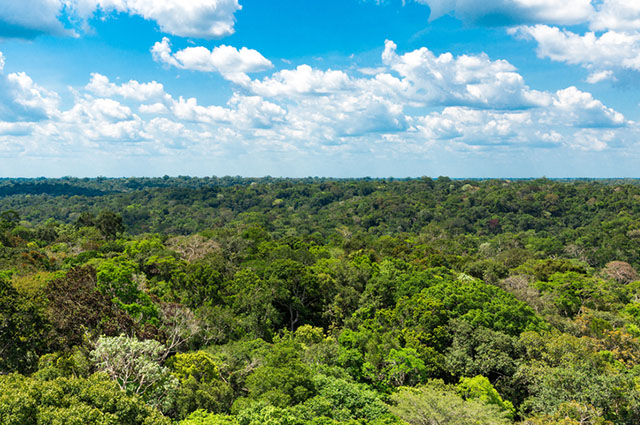
Promote and plan the development of nine states in the North and Northeast regions. This was one of the objectives of the Legal Amazon, created under Law 1,806 of January 6, 1953. The Legal Amazon covers an area of 5,217,423 km², corresponding to 60% of the Brazilian territory and includes the following states:
- Acre;
- Amapá;
- Pará;
- Amazonas;
- Rondônia;
- Roraima;
- Part of the states of Mato Grosso, Tocantins and Maranhão.
The socio-political bias was fundamental for the Legal Amazon, so it extends beyond the Amazon rainforest biome, covering part of the Cerrado and Pantanal. Even benefiting other types of vegetation, the limits of the region have been revised.
Preservation of forests and rivers
The creation of the Legal Amazon was a way of preserving the life of the Amazon rainforest and indigenous culture. Just to give you an idea, more than 55% of Brazilian Indians live in the region.
The watershed comprises the following rivers:
- Amazonas;
- Rio Negro;
- Solimões River;
- Xingu River;
- Madeira River;
- Tocantins River;
- Japurá River;
- Rio Juruá
Economic exploitation and lack of supervision
As it is very rich, the region of the Legal Amazon has, among its main economic activities, plant and mineral extraction, agriculture and fishing. There are also concentrated industrial activities (Manaus Free Trade Zone), services and trade.
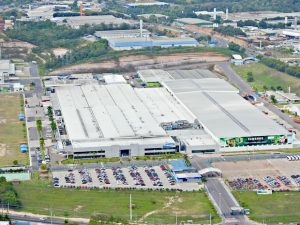
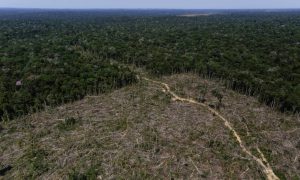
The planning of the Legal Amazon also consisted of organizing the activities practiced in the region. However, this is not the case. Economic development has been severely hampered. In view of this, deforestation and uncontrolled exploitation of the forest have had socio-environmental impacts.
The region faces many problems with logging, agricultural expansion and land conflicts have been known for years, but governments close their eyes and end up allowing illegal exploitation of the Amazon’s natural resources.
The lack of inspection is one of the reasons for the actions of illegal loggers, for the expansion of agriculture and for the actions of land grabbers.
Illegal deforestation
Deforestation in the Legal Amazon region grows every year. According to data released in November by the National Institute for Space Research (Inpe), from August 2018 to July 2019, there was an increase of 29.54% over the previous period. The highest index recorded since 2008.
O ato criminoso comprometeu uma área de vegetação nativa de 9.762 quilômetros quadrados (km²). O levantamento apontou que o Pará, no Norte do país, foi o mais prejudicado, com 39,56% da área desmatada. Em seguida aparecem os estados do Mato Grosso (17,26%), Amazonas (14,56%) e Rondônia (12,75%). Somente esses quatro estados foram responsáveis por mais 84% do território desmatado.
The devastating action of human beings has degraded 135 square kilometers of forests.
Endangered Indigenous Policy
With so many criminal actions for unrestricted exploitation of the Amazon rainforest, indigenous peoples are the ones who suffer most. First, because natural resources have become scarce and increasingly difficult to find.
Another very serious problem that the authorities refuse to see is the killings of indigenous people by land grabbers. Data from the Pastoral Land Commission (CPT) show that the number of indigenous leaders killed in 2019 is the highest in 11 years.
Seven leaders were murdered in 2019, against two in 2018. The deaths occurred in the states of Maranhão, Amazonas, Roraima, Pará and Amapá. The main motivation for the homicides is the fight for occupation of the Amazonian lands. Among other reasons are mining and illegal logging.
The Indian Missionary Council (Cimi) points to a 20% increase in the number of murders of indigenous people. The data also demonstrate that there was an increase in land invasions by these populations. There were 160 cases from January to September 2019.
Legal Amazon Timeline
- 1953: The Superintendence of the Amazon Economic Valorization Plan (SPVEA) was created by Law 1,806. Known as the Legal Amazon. The purpose was to develop the region’s economy in a sustainable manner;
- 1966: SPVEA was revoked by Law 5.173 of 1966. The legislation creates the Superintendence of Development of the Amazon (SUDAM). In this way, the Legal Amazon now covers the states of Acre, Pará and Amazonas, the territories of Amapá, Roraima and Rondônia, part of Mato Grosso, Goiás and Maranhão;
- 1977: Complementary Law nº 31/1977 extends the limits of the Legal Amazon, including Mato Grosso;
- 1988: With the Federal Constitution, Tocantins, Roraima and Amapá are transformed into Federated States, again expanding the area of the Legal Amazon;
- 2001: SUDAM is extinguished. The agency is replaced, through Provisional Measure 2.157-5, by the Amazon Development Agency (ADA);
- 2007: The enactment of Complementary Law No. 124 recreates SUDAM, which still works today.
Problems caused by the Legal Amazon
The purpose of integrating the states of the Legal Amazon to the country’s economy has seriously damaged the region, because it has opened up space for illegal explorations. The impacts on the environment are catastrophic.
Due to these actions, one of the large reserves of tropical wood faces an accelerated and predatory degradation process. All of this to exploit wood illegally. In addition to illegal logging, the Amazon is an area disputed by cattle producers. Agriculture has become an incalculable problem for the region, since it requires large areas of land.
The long-awaited economic development also brought hydroelectric dams, legal and illegal mining to the Amazon forest. Areas that should be protected are at the mercy of a group of people who advocate unlimited exploitation of forest resources. Nothing is out of reach for explorers, not even conservation units.
All this method used by grileiros, mining companies, ranchers, among others, causes social conflicts and deaths. That’s because, while indigenous leaders and NGOs are interested in protecting the forest and defending indigenous rights, the explorers do everything to get what they want, even kill.
For the Legal Amazon to become legal, it is necessary to increase inspection and tighten the laws. The green and the waters of the forest must be preserved. Various animals, marine specimens and peoples depend on the Amazon biome, but not only them, but also the rest of the planet. The imbalance in the region can damage the global climate and human survival. Therefore, it is necessary to revise the legislation so that the Amazon is preserved.