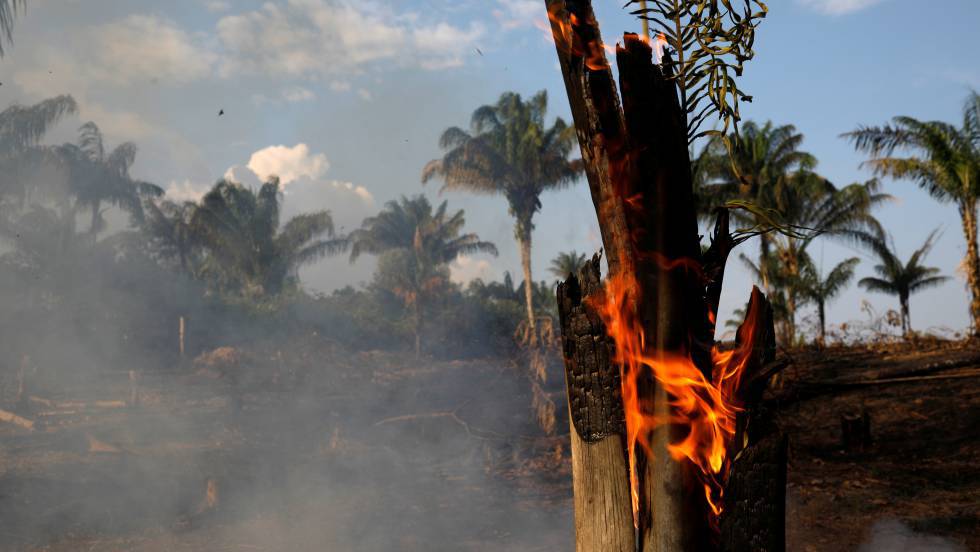
According to the climatology specialist Carlos Nobre, the Amazon must reduce the rates of deforestation and fires as it risks becoming a savanna in 30 years.
After the disclosure of data from the National Institute for Space Research (INPE) on the progress of deforestation in the Amazon, which in 2019 reached about 29.5% more than the deforestation rates in the same period of 2018, the climatologist in an interview warned of the risk.
What happens is that the intensification of mineral and vegetal exploration activities, as well as the expansion of agricultural frontiers in the Amazon region, have contributed to the ecological imbalance of the biome.
Point of no return
In some places, there are no more possible recovery measures to return the forest to its original state. This situation refers to the “point of no return”. The Amazon rainforest is a fragile ecosystem, which took years to develop and reach a climax.
This stage means that the forest has reached perfect balance, and that everything it consumes, it can produce, making it a self-sustaining ecosystem. However, any interference in this balance can have serious consequences and put at risk species of fauna and flora in the region.
Despite being very rich in biodiversity, the Amazonian soil is rich in organic matter, essential for maintaining the natural plant species of the forest. However, for agricultural activity, the need for deforestation makes the soil poor in nutrients, requiring the use of agricultural inputs.
Furthermore, burning vegetation and incorporating ash into the soil is a means of nourishing this soil for planting. Concomitant to this, the extraction of wood also causes a deficiency of many nutrients in the soil, such as nitrogen and potassium.
Therefore, the application of fertilizers can compromise, through the leaching and percolation of water in the soil, even some water resources existing in the region. These factors make it impossible to recover degraded areas in the Amazon, many of which are already at the point of no return.
Consequences of the damage caused
No matter what actions and measures are taken, the more the forest is damaged, reaching the point of no return, it will not be possible to maintain the Amazon as we know it today, and it will enter a process of desertification.
According to former director of INPE, Ricardo Galvão, this estimate of the forest reaching the point of no return may be only 15 years. Changes in the scenario of the Amazon region, such as the fires in this year 2019, have already influenced imbalances in rainfall regimes in different regions of the planet.
What happens is that the Amazon forest has vegetation resistant to natural fires. However, the decrease in vegetation density, associated with the activities of logging and intensification of agriculture, make the forest more fragile. This means that with the increase in the rate of deforestation, the Amazon rainforest will resist less and will succumb faster and faster.
Risks of rapid deforestation
The rhythms of environmental degradation are very worrying and can cause irreversible damage, which will influence all the biomes in the world. Due to the location of the area in a tropical zone, the chances of the Amazon to become savannah are great, as we know in Africa.
Since the colonization of Brazil, which promoted the exploitation of the Amazon rainforest from the beginning, to the present day, about 20% of the total forest area has been deforested.
The estimate is that, if this percentage reaches 25%, the forest will not resist and the biome will be at its point of no return. In this way, we are very close to one of the greatest environmental catastrophes ever imagined to date. It is for this reason that measures must be taken in order to promote the protection of these areas, due to their immeasurable value for life and biodiversity. The Amazon is home to about 45,000 species of plants and animals and regulates rainfall and climate throughout the planet.
In addition, this important biome is responsible for part of the production of oxygen (O2) and fixation of carbon dioxide (CO2), contributing to the improvement of polluted environments due to industrial activity in all countries in America and Europe.
This also implies an increase in global temperature in the coming years and an influence on the melting of polar glaciers. The Amazon may take centuries or even never fully recover from the fires.
The importance of diversity in the Amazon

Maintaining the life of species existing in the Amazon biome is also very important for activities such as hunting and fishing by riverside communities in the Legal Amazon.
In this perspective, ecological zoning policies are necessary to develop the economy in a structured way and that investments in technologies avoid environmental degradation to the detriment of agricultural activity.
There is also substantial punishment for environmental crimes in the Amazon, such as the fires that occurred this year. Brazil needs to turn its attention to actions to recover already degraded areas so that the Amazon rainforest gains momentum and is not extinguished.
The fires that have occurred can compromise the forest area in such a way that they no longer recover. And the most worrying is that these indiscriminate actions will be repeated, causing irreversible impacts to the Amazonian environment.
Legal Amazon and its implications
Not least, according to data from the Brazilian Institute of Geography and Statistics (IBGE), around 12.13% of the Brazilian population is concentrated in the Legal Amazon region, which means that about 20.3 million people in Brazil alone live close by the forest.
Many of these people benefit from local biodiversity for their livelihood. The legal Amazon covers the states:
- Acre;
- Amapá;
- Amazonas;
- Mato Grosso;
- Pará;
- Rondônia;
- Roraima;
- Tocantins; and
- parts of Maranhão and Goiás.
This means that the populations most affected by environmental destruction are located in these states and are also the most responsible for the sustainable economic development of the region.
Despite this, the vegetation of the Amazon is important for carrying out scientific research on the properties of plant species for the development of medicines and drugs that can benefit populations and promote the treatment of diseases worldwide. Species investigations can be done through exchanges with local indigenous cultures, which also need to be preserved.