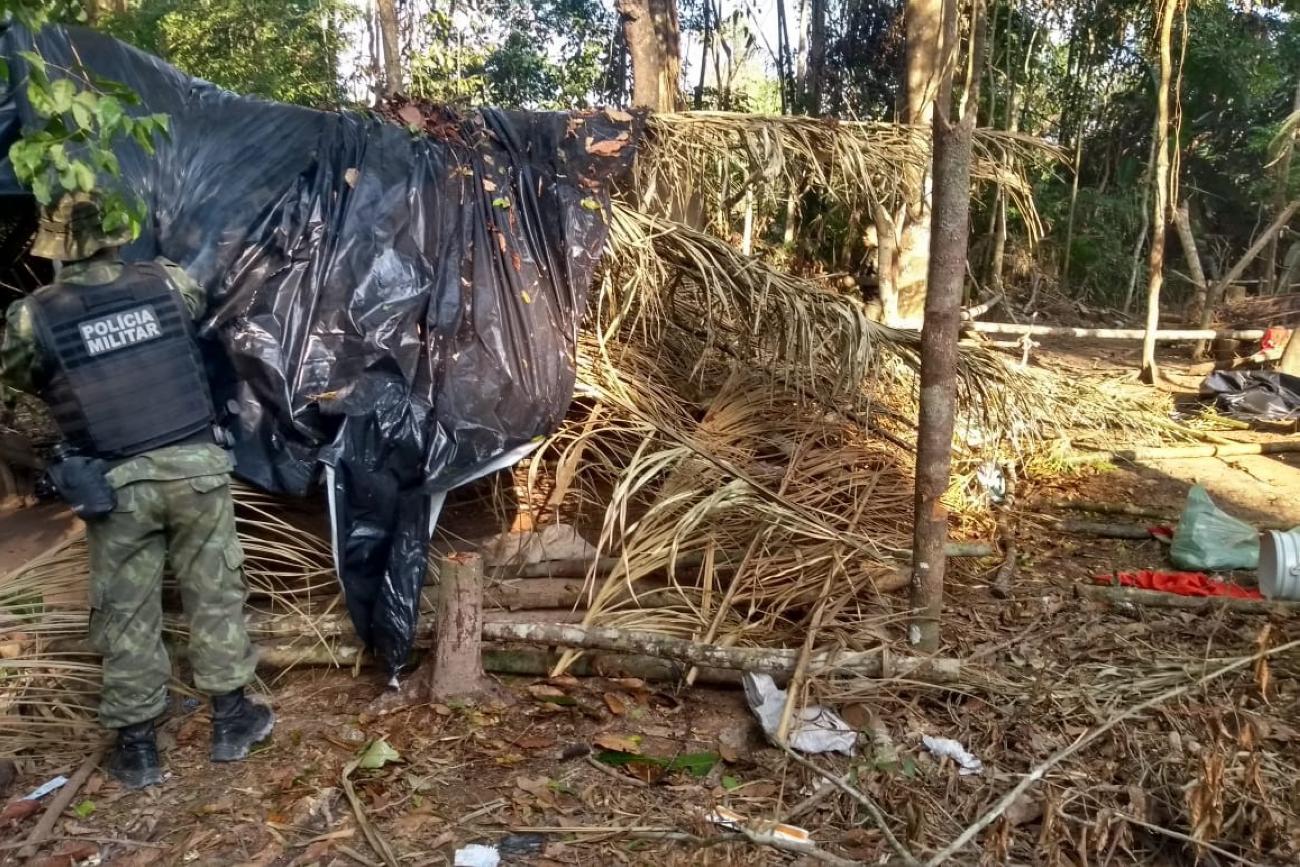
An illegal encampment was discovered within a reforested vegetable zone, in the municipality of Candeias do Jamari (RO), metropolitan region of Porto Velho. The Environmental Police Battalion (BPA) carried out the act in the last week of January.
It was already possible to find part of the deforested vegetation on the site. According to Lieutenant Danilo Melo: “They usually invade the area and do the first type of deforestation, with cutting trees on the spot. This is to leave vegetation dry. Then they set fire”.
The devastated area was recorded using an application. The irregular construction was dismantled by the environmental police and no one was arrested. Generally, when such camps exist, offenders use them to guard possible objects to be used in crime. In that sense, extra attention is needed in the area, warns the lieutenant.
The irregular camp found is part of an area that is being recovered by the battalion itself, in a period that has already taken 15 years. It comprises an extension of approximately 15 thousand hectares in the Preto River.
In August last year, two irregular camps had already been destroyed during an operation in the Triunfo do Xingu environmental protection area, comprised in the municipalities of Altamira and São Félix do Xingu. Offenders tend to build campsites with logs, leaves and some plastic tarps. Thus, they can be sheltered, in an irregular way, in order to extract wood in protected forests.
According to the State Secretariat for the Environment and Sustainability, Altamira and São Félix do Xingu are the municipalities that are in the first place in the ranking of irregularly deforestation in the legal Amazon and in Pará. Triunfo do Xingu is bordering between these two municipalities and, therefore, undergoes constant monitoring.
With the advent of State Decree no. 2,612 of December 4, 2006, the Triunfo do Xingu Environmental Protection Area was created, totaling 1,679,280.52 hectares. Of these, 66% are located in São Félix do Xingu and 34% in Altamira.
What are Nature Conservation Units (SNUC)?
Through regulation by Law 9,985 / 00, Conservation Units (UCs) are protected areas, given their natural characteristics. These zones can be divided into two groups:
- Sustainable Use UCS;
- Comprehensive Protection UCS
The Integral Protection UCS only allow the indirect use of natural resources. As some examples of this indirect use, we have:
- Eco tourism;
- Scientific research;
- Environmental education.
On the other hand, the Conservation Units for Sustainable Use, allow the sustainable activity of part of the natural resources that exist there. This group comprises:
- Environmental Protection area;
- Area of Relevant Ecological Interest;
- National Forest;
- Extractive reserve;
- Fauna Reserve;
- Sustainable Development Reserve;
- Private Reserve of Natural Heritage.
Regarding Environmental Protection Areas (APA), these are a vast region reserved for the protection of fauna and flora, in addition to being used for preservation, existing cases, of aesthetic or cultural attractions. Its primary objective is the maintenance of biodiversity through orientation, development and, above all, the reconciliation of human activities with the environment.
In general, APA, when it is a conservation unit for sustainable use, orderly human occupation is allowed. Thus, it is necessary that this occupation be based on the sustainable use of natural resources.
In addition, the establishment of PACs can take place on public or private land. When established on public lands, the conditions of use are defined by the agency responsible for the unit. And when on private land, conditions can be defined by the person responsible for the land, as long as they are in line with the legislation.
Unlike APAs, Permanent Preservation Areas (APPs) are not Conservation Units and, therefore, are not dependent on institutional acts. Its creation is based on the conditions of the land, that is, it is enough that the conditions are provided for by the current Forest Code (Law nº 12.651). Some examples of APPs:
- Watercourse margins;
- Restingas;
- Mangroves;
- Areas of altitude above 1800 meters.
The New Forest Code and deforestation
The main existing criticisms about the New Forest Code are related to the amnesty of fines, reduction of protected areas and reduction of vegetation restoration. This is due to the fact that the new law allows for the amnesty of fines for people who have deforested by June 22, 2008; reduction of calculation for configuration of the protected area; considerable reduction in the total of areas that would need to be reforested
In addition, one of the central changes of the New Forest Code was the emergence of the Rural Environmental Registry (CAR). This registration is mandatory for all rural properties in the country and is the first step towards their environmental regularization. Another point that is still not working in practice is related to the CRA (Environmental Reserve Quota), that is, it is configured in a title that has a surplus of Legal Reserve area.
On the other hand, although there are some changes established by the New Forest Code, between the years 2012 and 2016, there was a continuous increase in the rate of deforestation in the Amazon. The data obtained by PRODES (Project for Monitoring Deforestation in the Legal Amazon by Satellite) show an upward trend in the rate of deforestation, and in 2012 the rate reached its lowest peak.
It is observed that the increase in this rate of deforestation coincided with the publication of this code. For many, the increase was due to the fact that, with the launch of the New Code, there was flexibility in amnesty policies. On the other hand, the Ministry of the Environment attributed this increase to the political and economic crisis that Brazil has been facing. However, what is observed is that, in analysis of the official government indexes, the rate of deforestation, in the last period, between 2012 and 2016, grew by 75% when the official data were presented.
Finally, there is already movement within the National Congress in order for the New Forest Code to be revised. In short, greater pressure is required from society and also from the market, which may require zero deforestation in the production chain. This would undoubtedly help curb further increases in deforestation rates.