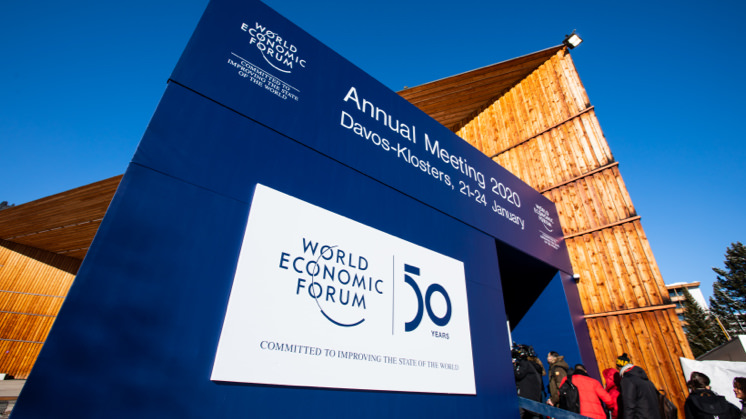
“Conserving the Amazon is much more profitable than replacing flowers with monoculture or livestock”. This was the reflection made by Professor Carlos Nobre, director of Brazilian Academic Science research, during a session in the auditorium of the World Economic Forum, in Davos.
Every year, the Forum gathers about 2 thousand people, including presidents, business, government, civil society leaders and representatives of different sectors to debate themes that rule the world economy.
In 2020, the World Economic Forum held its 50th annual meeting from January 21st to the 24th, the subject was “Interest groups for a cohesive and sustainable world”.
It was already expected that the Amazon would at some point be the focus of discussion.
And that was what happened on Wednesday, 22nd, in a special session on how to guarantee a sustainable future for the Amazon, with the participation of Carlos Nobre, Ivan Duque, Colombian president and Al Gore, former American vice president.
Here are the highlights of the panel about the Amazon.
But first, what is the World Economic Forum in Davos?
Established in 1971, the World Economic Forum (WEF) is a Swiss non-profit organization whose main objective is to be “committed to improving the situation in the world”.
In addition to discussions involving major representatives from various sectors, the Forum also generates research reports and engages in initiatives that try to solve global problems through public-private partnerships.
Now that you already know what the World Economic Forum is, and its importance not only for the economy, but also for the environment, let’s recap the panel highlights on how to guarantee a sustainable future for the Amazon.
-
Environmental crisis as a center of debate
More than ever, major economic risks are directly linked to issues of environmental emergency.
As the main theme of the 2020 Forum, the environmental crisis was discussed not only during the panel on the Amazon, but throughout the event, from discussions dedicated to traditional issues, such as international trade conditions, to technological changes and the perspectives of global economy.
-
Economic impacts
During the panel on how to guarantee a sustainable future for the Amazon, Carlos Nobre acknowledged climate change and its importance for the whole world, warning in detail about economic activity.
The scientist pointed out, for example, the exploitation of açaí (ah-sah-EE) as ten times more profitable than cattle ranching in deforested areas and used an argument with immediate translation into cash.
But the dramatic argument was different: if the turning point were been reached, the devastation would have reached 50%, or even 60%, and the forest would be unable to recover.
In this scenario, unfortunately a large part of the Amazon will become a dry savanna.
It is worth mentioning that Professor Carlos Nobre was the only Brazilian figure to participate in the debates on the environment in Davos, even with the presence of the Secretary for the Economy, Paulo Guedes, at the event, representing President Jair Bolsonaro, who did not participate in the event.
-
Climate change
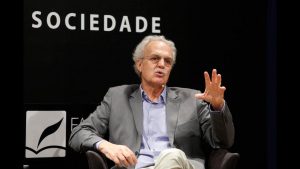
The professor also highlighted the dangers of climate change that will be caused in case of no real concern about the preservation of the Amazon.
According to him, the deforested Amazon will cease to function as a source of rain for other areas.
Since this is one of the functions of tropical forests, the side effect of climate change that is already being felt is prolonged droughts, a warning sign in various parts of the world.
-
Preservation campaign
One of the hallmarks of this year’s World Economic Forum meeting was a campaign to plant one trillion trees in ten years.
Although he rejected the alarming warnings about the global climate, the President of the United States, Donald Trump, showed support for the campaign, declared himself committed to preserving the environment and praised the forum’s initiative.
In addition to Trump, Colombian President Ivan Duque also joined the campaign.
Before the session on the Amazon, he had participated in an interview about the campaign regarding the planting of the trillion trees.
On the occasion, he spoke about Colombia’s plan to plant 180 million trees by 2022 – a plan already underway.
In addition, the president stated that the country has 35% of its territory in the Amazon and, therefore, his government already has a forest preservation program.
-
Brazilian presence (or lack of presence)
Brazil appeared in bad shape during the World Economic Forum, since the beginning of the debate on the sustainability of the Amazon.
During the session opening, the host recalled the fires of last year and quoted, without mentioning her name, the Secretary of Economy, Paulo Guedes. The day before, the Secretary had declared that there is link between poverty and deforestation.
Without the presence of President Jair Bolsonaro at the event, and the absence of Secretary Paulo Guedes on the panel, the Brazilian government was left out of debates about the environment and how to guarantee a sustainable future for the Amazon.
The absence, beyond putting the national government even in a certain position of villain on the subject, also opened space for the Colombian government to gain a lot of positive prominence.
So, what is your opinion about the main topics discussed in the panel on the Amazon at the World Economic Forum in Davos? What do you think should have been discussed, in addition to the topics above?