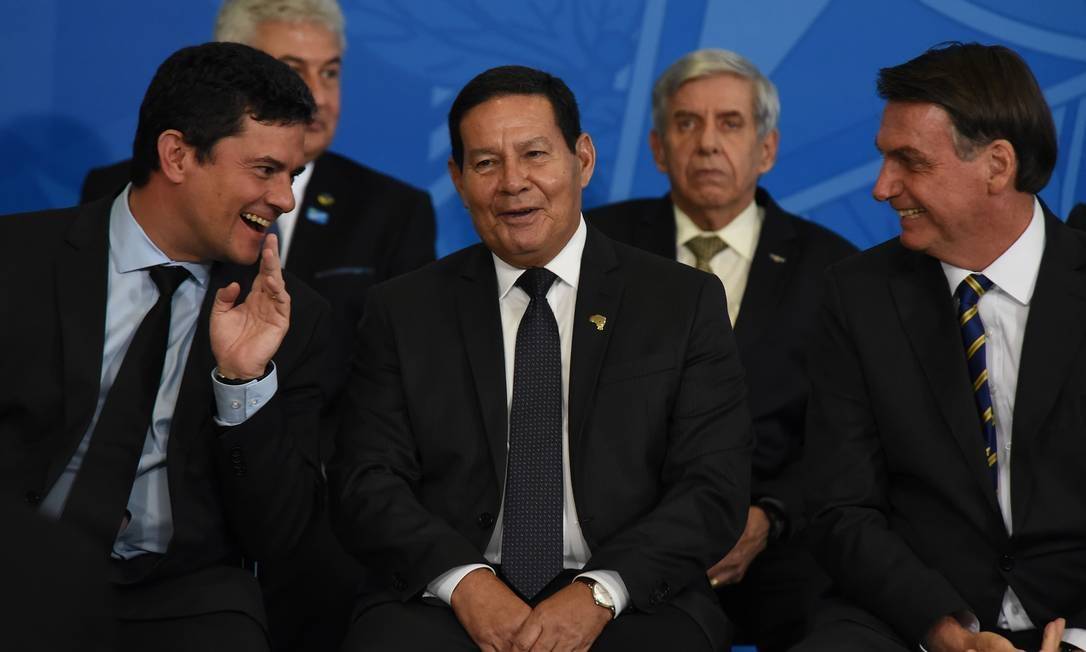
In February, President Jair Bolsonaro signed the decree transferring the National Council for the Legal Amazon from the Ministry of the Environment to the Vice Presidency.
The council will be integrated by Vice President Hamilton Mourão and 14 more ministers from the Federal Government, changing the previous composition. Defined in decree 1.541 of 1995, signed by then President Fernando Henrique Cardoso, the governors of the Legal Amazon were part of the council, which includes: Acre, Amapá, Amazonas, Pará, Rondônia, Roraima, Tocantins, Mato Grosso and Maranhão, were also part of the council 20 ministers and three representatives of federal agencies.
According to Mourão, even if the governors are no longer part of the council, they will still be consulted to indicate and establish what the priorities of their region are, the vice president also added saying that the council’s role is to integrate and coordinate policies in a federal level.
Together with Mourão, the ministers of the following portfolios will take part in the council:
- Institutional Security Office;
- Environment;
- Regional development;
- Justice;
- Civil House;
- Economy;
- General Secretariat for the Presidency;
- Agriculture;
- Defense;
- Foreign Relations;
- Presidency Government Secretariat;
- Mines and Energy;
- Infrastructure;
- Science, Technology and Communications.
It was defined by the decree that all members of the board must meet every quarter and, furthermore, they will be divided into thematic commissions. In addition, the text of the decree states that “The president of the National Council for the Legal Amazon and the coordinators of commissions and subcommittees may invite specialists and representatives of agencies or entities, public or private, national or international, to participate in the meetings” and the decisions were defined to be made by the chairman of the board, after the contributions of the other members.
When created, the council had the function of advising the President of the Republic in the formulation of public policies for the region and proposing measures, in addition to coordinating integrated actions in the Amazon. Still, according to the vice president, the new formulation of the board aims to adopt a posture that is more “proactive” in the environment.
The first measures to be taken by the Council, according to Mourão, are related to fires and deforestation in the region, and may even again request the support of the Armed Forces to prevent illegal actions in the territory.
Environmental neglect and international criticism
Reactivated, even in the midst of various criticisms by environmentalists and national leaders, this change in board members is just another part that was questioned and criticized in the midst of the entire environmental policy of the Bolsonaro government, where the environment was one of the most important points wear and tear in the first year of the president’s term, in which the deforestation of the forest registered a record growth of 29.5% in relation to the same period of the previous year.
The environmental policy made today does not only affect the environment, but the administration of the current government in relation to the issue, has affected the country on several fronts, including, from an economic point of view. The latter was already demonstrated a few months ago, when the great managers of foreign investment funds announced that they would not invest more money in Brazil.
Another point that demonstrates disregard for environmental policy is the relaxation that has been occurring on the part of the inspection bodies, when, from January to September 2019, the number of fines for illegal deforestation, issued by Ibama, dropped 25% in relation to the same period of 2018, going in parallel with the increase in deforestation, that is: less inspection, greater environmental damage.
Justification for changes in the board
Vice President Hamilton Mourão said that after observing the existence of several public policies that act practically independently, in the most different ministries and without any type of integration, there is only the waste of resources and the loss of effectiveness of the actions, thus, it justified the reason for the creation of the council with another structure. According to him, now, the command and control of these activities will be much easier, mainly in relation to the communication between the different government agencies and from this moment on, they will speak the same language, direct the intelligence to what happens in the Amazon region in order to start acting on time.
The power defined for the council will be to propose and monitor regional public policies, in addition to coordinating actions for prevention, inspection, repression of illicit acts and the exchange of information in the Legal Amazon.
Mourão, after the ceremony, guaranteed that the council will also listen to representatives of civil and academic society, in order to build public policies that can not only guarantee environmental preservation, but also offer sustainable development alternatives for the Amazon.
Global issue, international responsibility
The “environment” agenda is already definitive on the global agenda and, despite being relatively recent, it is increasingly in need of being a priority. One example of this worldwide visibility for the cause was the decision made by one of the largest funds in the world, BlackRock, which gave up investing in fossil fuel projects and companies to prioritize investments that are compatible with the sustainable development program.
With just one example, it is possible to perceive that the preservation of the environment will interfere more and more in business strategies, being a latent agenda and that increasingly charges different sectors of society, among them: governments, consumers, industries and etc.
The Stockholm Conference, which took place in 1972, and Rio-92 were the starting points for the growth in the number of natural resource management agreements between countries, and today, the environment, is the second area with the largest number of international agreements. in the world.
In Brazil, the main focus and criticism that comes from abroad are in relation to the preservation of the Amazon Forest, demonstrations were held worldwide to alert and demand a position on the fires and deforestation that have been occurring and growing rapidly in the region.
The Amazon Forest
The Amazon is the most valuable natural heritage on the planet, it is a synthesis of three complementary forms of capital: natural, social and economic. The Amazon Basin covers 7 million square kilometers, of which more than 5 million and a half square kilometers of tropical forest. It covers nine countries: Brazil, which has 60% of the forest in its territory, Peru with 13% and the other parts are in Ecuador, Colombia, Guyana, Venezuela, Suriname, Bolivia and France (French Guiana).
In short, our country has a great responsibility to the world in environmental issues, so it is necessary that all the measures planned do not come to harm, but rather, so that the territory is not destroyed.